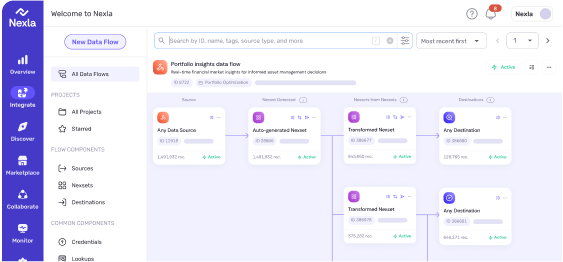
The short answer. Data for AI agents is enterprise data that has been integrated, governed, and packaged as discoverable, semantically rich products that AI agents can call at runtime. It is not the same as “AI-ready” data. Agent-ready data carries its own schema, access controls, freshness guarantees, and business context, so agents can reason, not hallucinate.
Why “AI-ready” is no longer enough
For most of the last decade, “AI-ready” meant clean, labeled data sitting in a warehouse. That was the right answer for predictive ML, where humans wrote the inference pipeline. It is the wrong answer for AI agents, which decide what to retrieve and what to call at runtime.
The gap is now measurable. Only about 7% of organizations describe their data as “completely ready for AI,” and roughly 60% of AI projects are projected to be abandoned because of weak data foundations. Eighty-eight percent of agent pilots never reach production, and the most-cited reason from CIOs surveyed by MIT Sloan and a16z is not model quality. It is the data layer underneath.
Agents do not need cleaner tables. They need data they can discover, reason over, and trust enough to act on.
The five things AI agents need from your data
Discovery. Agents need a registry, a catalog of what exists, what each thing means, and what an agent is allowed to use it for. Without that, every agent is a one-off integration.
Semantic context. A column called acct_st is invisible to an agent. A data product called “Customer Account Status, verified daily, owned by Finance” is callable.
Governance that survives the pipeline. RBAC, row-level security, and consent flags must travel with the data, through transformations, through embeddings, into the retriever.
Freshness SLAs. Agents acting on stale data are worse than agents that refuse to answer. Agent-ready data carries a known time-to-live, and pipelines tell the agent when the answer is too old to use.
A runtime interface agents can call. Today that usually means MCP servers, function-calling endpoints, or both, exposed in a discoverable way, not buried in a swagger doc.
AI-ready vs agent-ready data
Dimension
AI-ready data
Agent-ready data
Primary consumer
ML engineer
Autonomous agent at runtime
Form
Tables and features
Discoverable data products
Discovery
Schemas in a catalog
Tool descriptions, semantic metadata
Governance
Enforced before the warehouse
Enforced through the agent’s call
Freshness
Batch-aligned
Tied to SLA and agent contract
Failure mode
Bad prediction
Refuse, escalate, or retry
Score your data platform readiness for AI agents
Drag each slider from 0 (we don’t have this) to 5 (production-grade). Your score and recommendation update live.
0/ 100
Foundational
Start at the data product layer.Begin by inventorying the three agents you most want to ship and the data products each will need. Stand up a fabric on top of your existing sources, no migration required.
Scoring is illustrative. Treat the recommendation as a starting point for a more detailed assessment.
Build or buy: the architectural decision
Three architectures dominate in 2026.
The build-everything path stitches LangChain or LlamaIndex glue to a warehouse, a vector database, and a hand-rolled RBAC layer. It works for one or two agents and quietly collapses when the third agent needs the same data shaped a different way.
The buy-a-platform path standardizes on a vendor-neutral data fabric that produces governed, reusable data products (Nexla calls these Nexsets), wraps them with an MCP or function-calling interface, and lets any agent runtime, LangGraph, AutoGen, Bedrock AgentCore, Snowflake Cortex, Gemini Agent Platform, call them.
Most enterprises end up hybrid: vendor glue at the edges, a governed data product layer in the middle, and agent frameworks on top. The decision worth making deliberately is which of those layers is yours and which is bought.
Build vs buy your data platform for agents - 3-year cost calculator
Drag the sliders to model your situation. Costs are illustrative, adjust assumptions to match your reality.
Data sources to integrate20
550
AI agents in production target5
120
Engineering FTE (build path)4
110
Loaded eng cost / FTE / year$250k
$150k$400k
BuildLower 3-yr cost
$0
Engineering (3 yr)$0
Infra & maintenance$0
Initial build (one-time)$0
BuyLower 3-yr cost
$0
Platform license (3 yr)$0
Engineering (3 yr)$0
Onboarding (one-time)$0
Calculating...
Illustrative model. Build assumes engineering at full FTE, infra at $15k per source per year, and $25k per source for initial integration. Buy assumes a $150k base platform fee plus $5k per source per year, ~50% less engineering, and $30k onboarding.
What enterprise CDOs are demanding in 2026
Vendor neutrality. No agent strategy that locks the entire stack to one warehouse or one model provider.
Lineage and audit by default. Every column an agent reads, every prompt it runs, traceable end-to-end for regulators.
Reusable data products. Build once, serve many agents, and many human consumers too.
Real-time and batch in one platform. Agents do not get to wait for nightly ETL.
Governance through retrieval. ACLs that survive vectorization. If a user cannot see the row, they cannot see the embedding.
How to give your agents access without rebuilding the stack
The fastest path is rarely a rebuild. It is a layer.
Sit a governed data product layer on top of the warehouses, lakes, SaaS systems, and operational stores you already run. Define the data products your agents will need, accounts, transactions, contracts, support tickets, inventory, once. Expose them through an MCP server that enforces the same RBAC your warehouse already does. Let your agent frameworks consume them.
That is the architectural shape Nexla calls Data Variety to Agent-Ready Data. 550+ enterprise sources unified into governed Nexsets, data products with semantic abstraction, delivered as MCP-ready tools with context, identity, and zero-trust security built in at every step. The Data Loop is bidirectional by design: connect, abstract, govern, deliver, act.
FAQ
What is agent-ready data?
Enterprise data exposed as discoverable, governed data products that AI agents can call at runtime, with semantic context, access controls, and freshness SLAs intact.
How is it different from AI-ready data?
AI-ready data is shaped for a human-built ML pipeline. Agent-ready data is shaped for an autonomous agent that picks what to use at runtime.
Do I need MCP to expose data to agents?
You need a discoverable, governed interface. MCP is the dominant 2026 standard for that. Internal APIs work, but agents have to be hand-coded against them.
Will our warehouse handle this?
Warehouses are necessary. They are not sufficient. They lack discovery, runtime governance for agents, and a tool surface agents can call. You either bolt those on or run them as a layer above.
Next step
Map your top three planned agents to the data products they will need. If those products do not already exist as governed, callable surfaces, that gap is your work for the next quarter, not the model.
Data Platform for AI Agents: 7 Capabilities to Demand
A data platform for AI agents must do 7 things: connect, abstract, govern, deliver, act, observe, secure. Use this checklist to evaluate any vendor or stack.
How to Give AI Agents Access to Enterprise Data (Without Rebuilding Your Stack)
Give AI agents secure access to enterprise data without rebuilding your stack. Compare DIY vs. managed paths, see a 1-week vs. 12-week timeline, pick what fits.
Agentic RAG: How AI Agents Reason Over Enterprise Data
Agentic RAG replaces static retrieval with planning, tool use, and reflection. See the architecture, when to choose it over RAG, and metrics that actually matter.