
Free Enterprise Playbook

Your AI agents are ready.
Your data layer isn't.

Get the Enterprise Playbook to Agent Data Access. Connect your agents to governed enterprise data, without rebuilding your stack.

  • 4-step layered architecture, no migration required
  • 7-capability checklist to evaluate any data platform
  • MCP deployment patterns for enterprise data teams
  • 7-pillar readiness assessment, score your stack fist
  • 12-week implementation roadmap + printable vendor scorecard
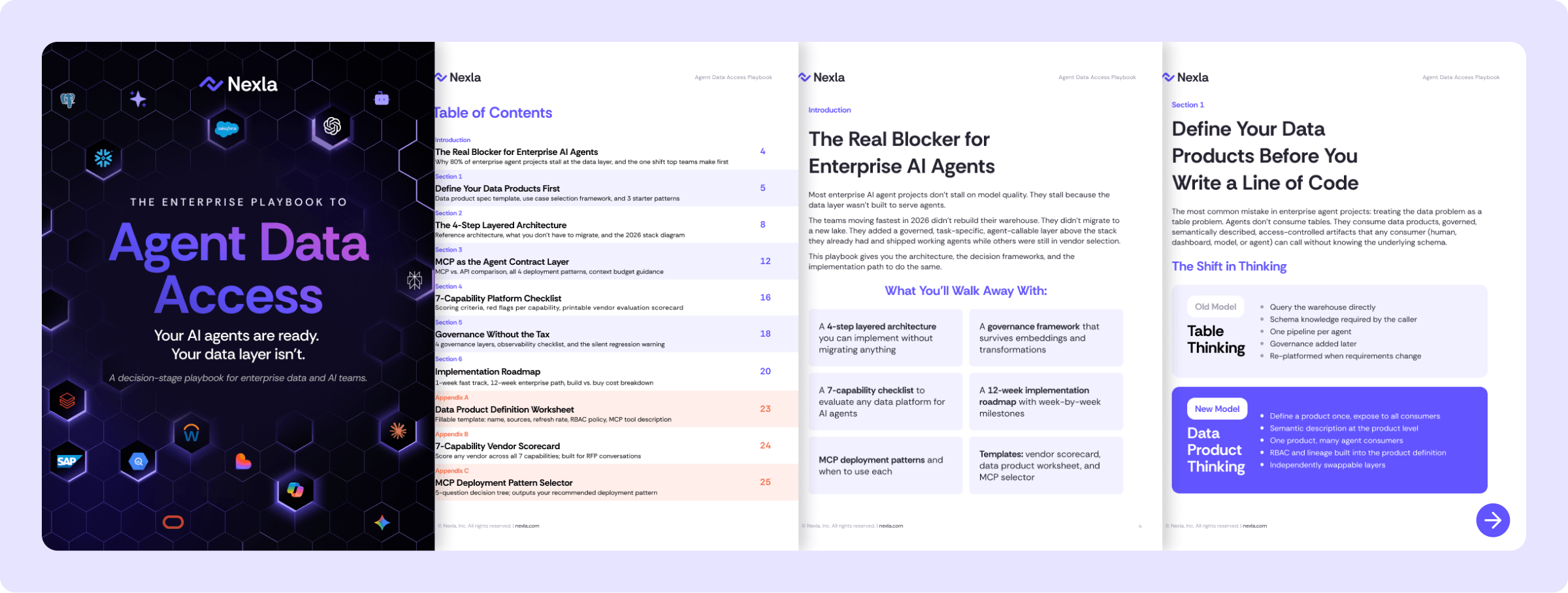
Nexla's Enterprise Playbook to Agent Data Access
What's Inside

A Playbook Built for Action, Not Just Reading

Every section is built around decisions, not concepts. You walk away with something to do.

Define Your Data Products

Complete a data product spec for your top 3 agent use cases using the included worksheet

The 4-Step Layered Architecture

Map your current stack to the reference architecture. Identify gaps without a migration plan

MCP as the Agent Contract Layer

Choose your MCP deployment pattern using the 5-question selector

7-Capability Platform Checklist

Score your current stack and any vendors you’re evaluating on the printable scorecard

Governance Without the Tax

Audit your RBAC propagation and observability setup against the governance layers framework

Implementation Roadmap

Choose your deployment path (1-week or 12-week) and assign week-by-week milestones to your team

Your AI agents are ready.

Get the data layer that matches.

Download the playbook used by enterprise data teams to move from blocked to deployed.

Nexla's Proven Impact

1T+

Records and Actions processed each month

10K+

Data pipelines across enterprise customers

360°

Context from Data, Documents, Video, Actions

1000+

Enterprise Data Connectors

<1 week

Median time to deploy a new connector with AI connector builder

15+

Gartner recognitions and report inclusions

Certified

SOC 2 Type II, plus GDPR and CCPA Compliant

Fortune 500

Data teams trust Nexla

Frequently Asked Questions

Who is this playbook for?

Enterprise data engineers, AI architects, and CDOs connecting AI agents to production data. It assumes you have a warehouse, lake, or SaaS ecosystem and need a practical path to make it agent-ready, without a full platform rebuild.

Do we need to migrate our data warehouse?

No. The 4-step architecture sits above your existing Snowflake, BigQuery, or Databricks environment. Your warehouse stays as the system of record. The data fabric reads from it; nothing moves.

What is MCP and why does it matter for enterprise data?

MCP (Model Context Protocol) is the 2026 standard for connecting AI agents to tools and data at runtime, without hardcoded API integrations. It lets agents discover what data products are available and call them with governed access. By Q1 2026, 78% of enterprise AI teams with 50+ practitioners had at least one MCP-backed agent in production.

What's the difference between this and a standard data integration platform?

The unit of value has changed. Traditional integration platforms move data between systems. A data platform for AI agents produces governed, agent-callable data products, discoverable via MCP, with RBAC enforced through embeddings and per-agent observability built in.

How long does it take to implement?

The playbook includes both a 1-week fast track (for teams with defined use cases and existing governance) and a 12-week enterprise deployment path. The readiness assessment above will tell you which path fits your situation.

How does Nexla help enterprises give AI agents access to data?

Nexla provides a managed data fabric that sits above your existing warehouse, lake, and SaaS systems, producing governed, agent-callable data products called Nexsets. No migration required. Three layers, one data fabric: source connectivity, governed data products, and an MCP server your agents can actually trust.

At the center of that layer is MCP Studio, Nexla’s conversational interface for building governed, task-specific MCP servers. Instead of hand-coding MCP integrations one by one, data teams define scope, access rules, and tool descriptions conversationally. The result is a production-ready MCP server that agents can discover and call, with full RBAC enforced from the data product up.