The short answer. The best data integration tool in 2026 depends on one question most lists never ask: can it produce data your AI stack can actually use? Fivetran (now merged with dbt Labs) remains the fastest path from SaaS sources to a warehouse. Airbyte owns the open-source lane. Informatica, Qlik Talend, and IBM carry the governance-heavy enterprise. MuleSoft, SnapLogic, and Boomi cover application integration. Nexla is the platform built around governed data products that agents, apps, and warehouses can all consume from one pipeline. This guide ranks all of them on connector breadth, CDC latency, pricing behavior at scale, and AI readiness, with the 2026 facts: four ownership changes in 19 months, three pricing models that quietly got more expensive, and a category racing to bolt on agent features.
One more reason the timing matters: Gartner sized this market at $5.9 billion in 2024 and, in the same breath, predicted that through 2026 organizations will abandon roughly 60 percent of AI projects unsupported by AI-ready data. The tool you pick to move data is now the tool that decides whether your AI projects are in the surviving 40 percent. That is the lens for everything below.
How we evaluated these data integration tools
Five criteria, weighted toward what actually changes outcomes in production:
Connector breadth, honestly counted. Vendors count connectors differently: Fivetran’s 700+ includes Lite connectors with fewer endpoints, SnapLogic’s 1,000+ Snaps includes templates, and Informatica’s 50,000+ counts metadata connectors. We note the definition behind every number.
CDC and real latency floors. Not the word “real-time” but the documented minimum: seconds, minutes, or an hourly sync floor. Most marketing sits one tier above reality.
Transformation depth. Does the tool own transformation, delegate it to dbt, or push it into the warehouse?
AI and agent readiness. Shipped, GA capabilities that make data consumable by agents: MCP support, semantic context, governed access. Not roadmap slides.
Pricing behavior at scale. The unit (rows, credits, capacity, connections) matters more than the entry price, because units age differently as volume grows.
Warehouse-loading speed alone no longer ranks a tool. Zero-ETL sharing and Iceberg (v3 went GA across major platforms in the first half of 2026) are absorbing the simplest copy jobs, and the growth in this category is shifting to data that feeds AI systems. It also matters what kind of tool you are looking at: a managed ELT pipeline (Fivetran, Airbyte, Stitch) moves tables to a warehouse, an iPaaS (MuleSoft, SnapLogic, Boomi) moves business events between applications, and a data layer for AI and agents (Nexla) packages data into governed data products with schema and context that warehouses, apps, and agents can all consume. Analytics engineers, application owners, and AI teams are buying three different things that all get called “data integration.”
The top 10 tools at a glance
Ownership is in this table because it changed four times in 19 months: Rivery went to Boomi (December 2024), Informatica to Salesforce (November 18, 2025), Confluent to IBM for $11 billion (March 17, 2026), and Fivetran completed its merger with dbt Labs (June 1, 2026). Who will own your tool in two years is now a legitimate selection criterion.
Tool
Type
2026 ownership
Pricing unit
AI/agent readiness
Nexla
Data layer for AI agents
Independent
Usage tiers (unpublished)
Nexsets + MCP Studio (Early Access), Express
Fivetran + dbt
Managed ELT
Merged June 2026
MAR per connection
Managed Data Lake (Iceberg), dbt semantic layer, MCP for pipeline ops
Airbyte
Open-source ELT
Independent
Volume or capacity (“Data Workers”)
Airbyte Agents + MCP servers (May 2026)
Matillion
Warehouse-native ELT
Independent
Credits (task hours)
Maia agents GA on 4 warehouses
Informatica
Enterprise data mgmt
Salesforce (Nov 2025)
IPU consumption
CLAIRE Copilot GA, MCP servers GA on Amazon Quick
Qlik Talend
Hybrid ETL + CDC
Qlik (Thoma Bravo)
Capacity by data moved
MCP Server GA Feb 2026, Open Lakehouse
IBM watsonx.data integration
Enterprise ETL + streaming
IBM (+ Confluent, Mar 2026)
VPC capacity / Resource Units
Unstructured-doc pipelines for RAG (GA)
MuleSoft
iPaaS / API-led
Salesforce
vCores or flows/messages
Agent Fabric (phased through July 2026)
SnapLogic
iPaaS + agents
Independent
Quote-based platform tiers
AgentCreator GA since 2024, MCP native
Boomi
iPaaS + ELT/CDC
Francisco Partners/TPG
Connections + BDU credits
Agentstudio GA, Agent Control Tower
Stitch, which most older lists still include, is deliberately not ranked. It is still sold from $100 a month, but its catalog has been frozen since roughly 2023 and its own homepage steers new buyers to Qlik Talend Cloud. There is no official end-of-life date, and vendor blogs claiming one are wrong. But buying a product whose vendor points you at its successor is a procurement anti-pattern.
Rather than reading all ten profiles, you can let your constraints do the sorting:
Find your shortlist: pick your constraints
Answer five questions the way you would in a vendor call. The ranking recalculates as you click.
Best matches
Directional fit, not a benchmark. Scores reflect each platform’s design center as of mid-2026; always run a proof of concept on your own data.
Nexla: built for AI-ready data products
Full disclosure up front: this is Nexla’s blog, so judge the claims on their specifics. Here are the specifics.
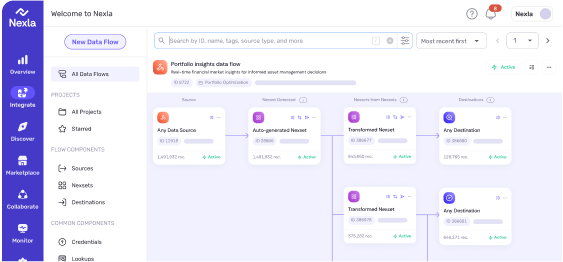
Nexla’s core design decision is that the output of integration should not be a pipeline, it should be a data product. Every source Nexla connects is automatically profiled into a Nexset: a governed unit that carries schema, validation rules, access controls, and version history. Non-breaking schema changes extend a Nexset in place. Breaking changes mint a new version instead of silently mutating what downstream consumers depend on. That versioning-first handling of schema drift is a concrete mechanic you can compare directly against connector-level schema policies elsewhere.
Why does that matter for AI? Because a Nexset is protocol-independent. One CDC connection from Postgres can simultaneously feed Snowflake for analytics, a Kafka topic for engineering, reverse ETL into Salesforce, and an MCP tool that an agent queries, all from the same governed definition. With pipeline-first tools, each of those is a separate product, sometimes a separate acquisition. This is what “semantic data layer” means at the pipeline level, and we cover the concept in depth later in this guide.
Converged styles. Batch ELT, log-based CDC (Postgres, MySQL, Oracle, SQL Server, MongoDB), Kafka streaming, API and SOAP integration, B2B/EDI feeds, and reverse ETL in one runtime. Real-time delivery is minutes-level (Nexla’s own FAQ says under 5 minutes), not sub-second, and we would rather tell you that than market “instant.”
No-code, low-code, and code. Visual mappers for business users, a CLI and Python SDK for engineers, and Express, which turns a plain-English description into a working pipeline on a free tier.
Agent-facing by design.MCP Studio (Early Access since June 2026) builds governed, task-specific MCP servers: credentials stay in Nexla, agents never see secrets, and every tool call is logged. Agents can also build pipelines through Express MCP, not just query data.
Enterprise controls. Private VPC and on-prem deployment, audit logs, error quarantine, and role-based access on the upper tiers. Rated 4.9 out of 5 on Gartner Peer Insights (about 80 reviews as of spring 2026), the highest in the data integration market for the fourth consecutive year.
With 1,000+ connectors and one governance model across every integration style, the tool-sprawl line items this list otherwise adds up tend to collapse into one platform.
Fivetran + dbt: fastest to the warehouse, priciest to churn
Fivetran is the default answer for hands-off SaaS-to-warehouse ELT, and since June 1, 2026 it is also the owner of dbt: the all-stock merger closed with George Fraser as CEO and Tristan Handy as president, roughly $600 million in combined revenue, and an estimated 80 to 90 percent of Fivetran customers already using dbt. Add the Census acquisition (now “Activations” for reverse ETL) and the Managed Data Lake Service writing Iceberg and Delta with a built-in Polaris-based catalog, and the pitch is one platform for extract, load, transform, and activate.
The capability is real: 700+ managed connectors, log-based CDC on the major databases, one-minute syncs on Enterprise and Business Critical plans (five-minute floor on Standard), and the deepest transformation story in the category now that dbt is in-house. Note the fine print on both halves: dbt Core v2.0 on the new Fusion engine is alpha, not GA, and sub-minute replication means running HVR 6, a separately licensed self-hosted product, not a toggle in cloud Fivetran.
The reason practitioners hesitate is pricing mechanics, not features. Three changes since March 2025 compound each other:
MAR went per-connection (March 2025), ending account-wide volume pooling. Third-party analyses report 40 to 70 percent increases for multi-connector accounts; Fivetran’s own FAQ counters that most customers saw a reduction. Both can be true: spreading the same rows across many connectors now costs more, concentrating them in one costs less. Model your own shape.
Deletes bill as MAR (January 2026). GDPR purges, TTL cleanups, and dedupe jobs now generate integration spend.
A $5 monthly base charge now applies to every standard connection generating between 1 and 1 million MAR, which adds up for teams with dozens of small sources.
On AI readiness: Fivetran’s MCP server manages pipelines (trigger syncs, check health), it does not serve data to agents. The actual agent story is the Iceberg lakehouse plus dbt’s semantic layer plus the new open “Agents Schema” standard, all of which assume your AI consumes from the warehouse. If your agents need data that never lands in a warehouse, this stack does not address it.
Informatica, Qlik Talend, and IBM: the enterprise heavyweights
Informatica, now “Informatica from Salesforce” after the $8 billion acquisition closed on November 18, 2025, remains the deepest governance stack: catalog, MDM, data quality, lineage, and mature log-based CDC in one platform, a Gartner MQ Leader for the 20th consecutive year. Its AI story is further along than “legacy” suggests: CLAIRE Copilot went GA in May 2025, the Data Quality Agent and headless data management went GA in the Spring 2026 release, and Informatica MCP servers are GA on Amazon Quick in US regions. Two cautions. First, IPU consumption pricing is genuinely hard to forecast: different services burn IPUs on different meters, and unused Flex IPUs expire at contract anniversary. Second, the PowerCenter cliff already happened: standard support for 10.5.x ended March 31, 2026, so the installed base is now choosing between paid extended support (to March 2027), a 12-to-18-month IDMC migration, or a competitor. Qlik is openly campaigning for those customers.
Qlik Talend is the sleeper of the trio for one reason: Replicate, the former Attunity engine, is one of the most battle-tested log-based CDC products in existence, with seconds-level latency and mainframe coverage most rivals lack. Architecturally distinctive: the Data Movement gateway runs in your VPC, so high-volume replication never transits Qlik’s cloud, which matters for egress, latency, and compliance. Qlik Open Lakehouse (GA September 2025) lands CDC straight into managed Iceberg, and the Qlik MCP Server went GA in February 2026, with declarative pipelines declared GA at the end of June 2026. The downsides are portfolio sprawl (Qlik Talend Cloud, Talend Data Fabric, Replicate, and Stitch overlap), capacity meters that make quarter-over-quarter costs hard to predict, and the community bruise of Talend Open Studio’s discontinuation in January 2024, which means no free Talend exists anymore.
IBM consolidated DataStage, StreamSets, log-based replication, and Databand observability into watsonx.data integration (launched June 2025, on AWS Marketplace since March 2026), then bought Confluent outright for $11 billion (closed March 17, 2026). That gives IBM a genuine sub-second streaming backbone next to a proven parallel batch engine, plus GA unstructured-document pipelines that turn PDFs and presentations into RAG-ready data, a differentiator none of the ELT tools match. It remains a platform you buy as part of an IBM estate: capacity pricing (VPCs self-managed, Resource Units as SaaS) is opaque, self-managed deployment requires OpenShift, and almost nobody net-new adopts DataStage standalone. When these three make sense: regulated industries, existing enterprise agreements, mainframe-adjacent data, and governance requirements that a pipeline tool alone cannot satisfy.
Airbyte, Matillion, and Stitch: the cloud-native contenders
Airbyte is the connector-breadth play with an open-source escape hatch: 619 catalog connectors (the famous “5,000+” figure counts user-built no-code connectors, a different population), self-hosting for sovereignty, and Enterprise Flex for hybrid control planes. Airbyte 2.0 (October 2025) brought claimed 4-to-6x sync speedups and GA reverse ETL, and Airbyte Agents (May 2026) added semantic search over synced data, 50+ Agent Connectors, and three MCP servers, the most aggressive AI pivot in the open-source lane. Two honest limits. Cloud is batch with a 60-minute sync floor on Standard (15 minutes on Plus) and schedule accuracy of plus or minus 30 minutes, so calling it real-time is wrong. And self-hosting shifts reliability to you; production complaints about connector quality and debugging are common enough to factor in, though the loudest documentation of them comes from competitors.
Matillion is the transformation platform of this trio: visual-plus-code pipelines pushed down into exactly four warehouses (Snowflake, Databricks, Redshift, BigQuery), and the most production-ready agentic authoring story among pure ELT vendors. Maia, its “team of AI data engineers,” reached GA on all four warehouses by July 2026, and its Migration Agent (March 2026) auto-converts legacy PowerCenter, DataStage, and SSIS pipelines, aimed squarely at the enterprise migration wave. Watch the pricing physics though: credits burn on task hours, so a slow warehouse literally doubles your integration bill, and Maia itself has no published pricing yet. If your destination is not one of the big four warehouses, Matillion is not your tool.
Stitch gets the honest paragraph few lists write. It is not dead: you can still swipe a card for $100 a month, and maintenance updates continue. But the catalog has been frozen since about 2023, there are no AI or agent features and no prospect of any, and Qlik publishes official migration guides to Qlik Talend Cloud while the Stitch homepage advertises its successor. No official EOL exists, and claims of one are unsubstantiated. For existing customers with simple, row-cheap syncs, deferring migration is rational. For new adoption in 2026, it fails the most basic test: the vendor itself is pointing you elsewhere.
MuleSoft, SnapLogic, and Boomi: the iPaaS players
The rule that keeps you out of trouble: buy an iPaaS when the unit of work is a business event that must reach another application with guarantees (an order hitting the ERP, a case triggering billing). Buy a data pipeline tool when the unit of work is a table that must land fresh and complete. iPaaS platforms lose on analytics because you pay application-integration prices (per vCore, per connection, per message) for bulk rows.
MuleSoft is the strongest API-led integration layer in the Salesforce world, and its Agent Fabric (agent registry, broker, and MCP/A2A governance through Flex Gateway) rolled out in phases from September 2025 through the July 2026 release notes. But it has no log-based CDC engine, its DataWeave language is a hiring tax, and licensing advisories report buyers committing to 40 to 70 percent more vCore capacity than they use. The bigger 2026 signal: with Informatica in the building, Salesforce now positions MuleSoft for APIs and agents, and Informatica for data pipelines. If you run analytical ELT on Mule vCores, expect your account executive to propose a migration.
SnapLogic has the earliest shipped agent tooling in the category: SnapGPT since 2023, AgentCreator GA since late 2024 and MCP-native since April 2025, plus an AI Gateway and Trusted Agent Identity announced in April 2026. It is a genuine one-platform, low-code story across apps and data, and a Gartner Visionary in both the data integration and iPaaS quadrants. Its database CDC is polling-based rather than log-based, its sub-second Ultra Pipelines apply to messages rather than bulk replication (and are typically a paid add-on), and it has raised no primary funding since December 2021, which is worth weighing on a five-year platform bet.
Boomi is the breadth-per-dollar option: app integration, B2B/EDI, MDM, API management, and, since acquiring Rivery (December 2024), genuine log-based CDC and warehouse ELT as “Boomi Data Integration,” with a vendor-published $0.90 per BDU credit at the entry tier. Its agent governance is concrete: Agentstudio went GA in May 2025, and Agent Control Tower registers and monitors agents from Bedrock, Agentforce, and Copilot with a kill switch. The caveat is architectural: core Boomi and the Rivery-derived data platform are two products on two unrelated meters (connections plus credits), and the integration between them is still maturing.
What is a semantic data layer for AI, and who actually has one?
A semantic data layer attaches business meaning to data: what this field is, what values are valid, who may see it, how it relates to the entities your business runs on. The term hides an important split. BI semantic layers (dbt MetricFlow, Cube, Looker, AtScale) define metrics for query time, answering “what does revenue mean” when a human or agent asks the warehouse. Pipeline-level context attaches meaning to data as it moves, so every consumer, warehouse, app, or agent inherits the same schema, validation, and access rules regardless of protocol. An agent reading a bare table sees cust_stat: 3. An agent reading a governed data product sees a customer status field with documented meaning, allowed values, and lineage, and that difference is most of why agents hallucinate on raw enterprise data. Both layers now converge on MCP as the delivery interface, and the vendor-neutral Open Semantic Interchange spec published its first version in January 2026.
Scoring this list against that definition: Nexla builds the pipeline-level layer as its core abstraction (Nexsets carry schema, semantics, and governance from ingestion onward). Fivetran + dbt delivers query-time semantics through dbt’s semantic layer, warehouse-centric by design. Informatica has the deepest metadata estate via CLAIRE and its catalog. Qlik Talend contributes AI-ready open formats through Iceberg. Most of the rest deliver raw pipe: capable movement with meaning left as an exercise for the consumer. G2’s 2026 research on AI in data integration found the technology’s real gains land in maintenance and monitoring rather than initial setup, and that AI still fails on context-heavy, partner-specific logic. Context is exactly the part a semantic layer carries, which is why “does the tool produce context, or just rows” is the sharpest single question in this category.
How to choose the right tool for your stack
The selector above encodes the decision tree; here it is in words.
Warehouse-first analytics, nothing else: Fivetran + dbt for managed convenience, Airbyte for open-source control, Matillion if your center of gravity is transformation inside one of the big four warehouses.
AI-first (agents and LLM apps consume the data): shortlist by governed, agent-consumable output: Nexla for data products with MCP delivery, Informatica if you are already inside its governance estate, Airbyte if you want open-source plus its new agent connectors.
Application-integration-first: MuleSoft in Salesforce-heavy API estates, Boomi for mid-market breadth including EDI and MDM, SnapLogic for low-code speed across both apps and data.
All three at once: this is where converged platforms earn their premium over stitching a per-category best-of-breed stack; Nexla and Boomi are the two credible one-platform answers, with opposite centers of gravity (data products vs app integration).
Questions that separate vendors in a proof of concept: Is CDC log-based or polling? What is the documented sync floor on the tier I am actually buying? What happens to my bill if row churn doubles, if my warehouse slows down, or if I add 20 small connectors? Do transforms live in your tool, in dbt, or in my warehouse? Can an agent consume your output through MCP without seeing credentials? And on 2026’s evidence, add: who owns you, and what happens to my contract at renewal if that changes? Then match the pricing unit to your team’s skills and growth: seats and capacity age well for predictable teams, consumption units (MAR, IPUs, task-hour credits) reward small workloads and punish growth, and every “contact sales” price deserves a modeled 3x-volume scenario before signature.
Frequently asked questions
What is the best data integration tool for AI agents?
The best tool is the one that delivers governed, context-rich data agents can consume directly. Nexla is built around that model: Nexsets carry schema and governance, and MCP Studio exposes them to agents as task-specific tools. Warehouse-native alternatives (Fivetran + dbt, Informatica) work well when agents consume from the warehouse.
Does Fivetran support real-time data integration?
Not in the streaming sense. Cloud Fivetran uses log-based CDC delivered in batch syncs: a 1-minute floor on Enterprise and Business Critical plans, 5 minutes on Standard. True sub-minute replication requires HVR 6, Fivetran’s separately licensed, self-hosted product. For seconds-level needs, look at Qlik Replicate-class CDC or streaming platforms.
What is a semantic data layer for AI?
A layer that attaches business meaning (definitions, valid values, relationships, access rules) to data so AI systems can interpret it reliably. BI semantic layers like dbt MetricFlow define metrics at query time; pipeline-level context like Nexla’s Nexsets attaches meaning as data moves, so every consumer inherits it regardless of protocol.
How is Nexla different from Fivetran?
Fivetran moves tables into warehouses and, post-merger, transforms them with dbt. Nexla produces data products: one connection feeds a warehouse, a Kafka topic, reverse ETL, and an agent-facing MCP tool from the same governed definition. Fivetran bills per-connection MAR; Nexla uses usage tiers. Different design centers: replication vs reusable products.
Which data integration tools support CDC (change data capture)?
Log-based CDC: Fivetran (plus HVR for sub-minute), Qlik Talend via Replicate, Informatica, IBM Data Replication, Nexla, Boomi via Rivery, Airbyte, and Matillion on its Scale tier. SnapLogic and MuleSoft rely on polling or platform events instead. The differentiator is the latency floor: seconds (Replicate, HVR), minutes (most), or an hourly cloud floor (Airbyte Standard).
What is the difference between ETL and ELT tools?
ETL transforms data before loading it (Informatica, Talend, DataStage); ELT loads raw data and transforms inside the warehouse (Fivetran + dbt, Airbyte, Matillion). ELT won the cloud-warehouse era because compute moved to the destination. Converged platforms like Nexla support both, applying transformation wherever the workload needs it.
What data integration tools work with Databricks?
All ten support Databricks as a destination. Matillion pushes transformations into Databricks compute and runs Maia agents there. Fivetran’s Managed Data Lake writes Delta and Iceberg with Unity Catalog support. Nexla delivers governed Nexsets to Databricks alongside non-warehouse destinations. Airbyte, Informatica, and Qlik Talend all ship native Databricks connectors.
Is Fivetran or Informatica better for enterprise data pipelines?
Different jobs. Fivetran + dbt wins for fast, managed SaaS-to-warehouse ELT with modern transformation. Informatica wins when you need governance, MDM, data quality, and catalog in the same platform, and when regulated-industry controls matter more than setup speed. Many enterprises run both; consolidation pressure usually favors whichever side owns governance.
What does “AI-ready data” mean in data integration?
Data an AI system can consume without a human explaining it: documented schema and semantics, governed access, freshness guarantees, and delivery through interfaces agents use (MCP, APIs, vector stores). Gartner predicts organizations will abandon about 60 percent of AI projects unsupported by AI-ready data through 2026, which makes this the defining requirement.
Which data integration platforms support both batch and streaming?
In one platform: Nexla (batch, CDC, and Kafka streaming through the same Nexset model), IBM watsonx.data integration (DataStage batch plus StreamSets, plus Confluent), and Qlik Talend (batch ETL plus Replicate CDC). Fivetran, Airbyte, and Matillion are batch engines; their “streaming” is scheduled micro-batch, with floors from 1 to 60 minutes.
Next step
Shortlists are cheap; proofs of concept are where these tools separate. Pick the two or three that survived your constraints above, bring one high-churn table and one AI use case, and watch the pricing meter and the latency floor, not the demo. If governed, agent-ready data products across every integration style is the shape you need, see Nexla on your own data.
AI Agents for Data Engineering: What They Actually Automate
What AI agents actually automate across the data engineering lifecycle, schema inference, pipeline generation, quality, lineage, and where warehouse-native agents on Snowflake, Databricks, Fabric, and BigQuery still fall short across clouds.
AI-ready data is governed, semantically described, and pipeline-stable. Get the 2026 definition, a checklist, and the gap from analytics-ready to AI-ready.