The 8 Best No-Code ETL Tools With Pre-Built Connectors and Live Pipeline Monitoring (2026)
Explore the top no code ETL tools for 2026 and compare connectors, transformations, monitoring, pricing, and best fit use cases.
Jul 27, 2026

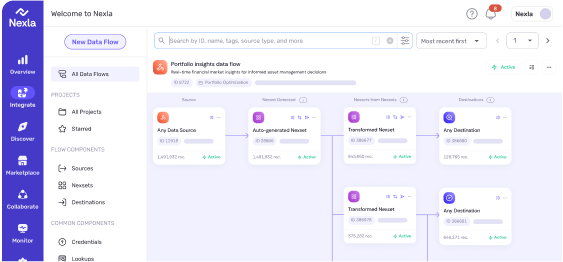
The short answer. A production agent data feed is a governed pipeline that connects live enterprise sources to an AI agent with schema normalization, access control, and drift monitoring built in. Nexla does this by auto-generating Nexsets from connected sources and delivering them through an MCP Gateway, replacing hand-coded connectors.
AI agent frameworks like LlamaIndex and LangChain are explicit about what they do and don’t do. LlamaIndex’s own documentation describes data connectors (Readers) as tools that ingest data into a Document representation, and treats indexing and retrieval as a separate downstream step. Neither framework’s ingestion layer handles ongoing scheduling, credential rotation, or schema monitoring across live sources. That work falls on whoever is building the agent.
This gap shows up as engineering time. A 2026 survey covered by BigDATAwire found that a majority of data engineers spend more than half their time handling data issues rather than building new capabilities, and a separate 2026 industry analysis found that organizations running 200+ active pipelines spend an average of 61% of engineering time on maintenance. None of that time goes toward the agent logic itself, it goes toward keeping connectors alive.
This tutorial walks through setting up a multi-source data feed for an AI agent using Nexla, a managed data-delivery layer that sits between your sources and your agent framework.
Chunking and embedding data into a vector store is a retrieval-layer concern. Before that step, the data has to be normalized into a consistent schema, refreshed on a cadence that matches how often the agent queries it, access-controlled so the agent only sees what it’s authorized to see, and traceable back to its source. Vector-store readiness is downstream of that work, not a substitute for it.
Nexla’s connector library currently lists 1000+ bidirectional, pre-built connectors spanning databases, SaaS APIs, file/cloud storage, streaming platforms, LLMs, and vector databases, with new connectors added weekly. For a typical agent data feed you’d connect three source types:
Each connection goes through Nexla’s Zero-Trust Identity Flow: user auth key, credential mapping and verification, connector, then source system. No manual credential management per source.
Rather than hand-writing a schema mapping, Nexla’s Agentic Probe scans each connected source and auto-generates a Nexset, a governed data product with schema, samples, descriptions, and lineage attached. You set the refresh schedule and apply any quality rules on top of the auto-detected structure. This is the “data product” hand-off unit between your data layer and your agent layer.
The Nexset is delivered to the agent (or to your vector store loader) through Nexla’s MCP Gateway, with identity verification on every request. If you’re using LlamaIndex or LangChain for retrieval orchestration, the Nexset becomes the clean, current input to your loader, replacing a hand-coded connector.
On every subsequent ingestion cycle, Nexla compares the structure of newly ingested data against the existing Nexset schema. Minor changes, like a new attribute, are absorbed automatically. Structural changes significant enough to affect downstream processing generate a new detected Nexset instead of silently breaking the existing one. This addresses a failure mode that’s easy to underestimate: an agent confidently answering from stale or malformed data because nothing upstream flagged the change.
Credential rotation and token refresh are handled at the connector layer, not left to the engineering team to track per source. Nexla’s documentation on schema change detection covers how detected changes are surfaced before they propagate into agent-facing data.
Nexla is SOC 2 Type II certified, GDPR compliant, and HIPAA compliant, with row- and column-level access control enforced at the Nexset level and a full audit trail on every data request, agent action, and write-back. For agents pulling from sensitive sources (health records, financial data, PII), this is enforced at the data layer, not left to prompt-level instructions.
These operate at different layers. LlamaIndex and LangChain orchestrate retrieval once data is indexed. Nexla handles what happens before that: connecting, normalizing, scheduling, and governing the data those frameworks consume. Use LlamaIndex or LangChain alone if you have one or two well-behaved, static sources. Use Nexla if you have several live sources, need governed access control, or want the data layer to keep functioning without an engineer re-touching it every time a source’s API changes.
It is the agent-era evolution of one. The base capability, moving and shaping data, is the same. The added capabilities (data products, MCP, agent governance, eval) are what define the new category.
Often partially. Warehouse-native options are strongest on storage and analytics; weakest on cross-source coverage and vendor neutrality.
Very. Locking the data layer to one model provider or one warehouse undermines every agent strategy that assumes a multi-model, multi-cloud future.
Nexla positions itself as the data platform for agents specifically, Nexsets as the product abstraction, an MCP server that supports building pipelines, and governance layered through both.
The companion how-to post walks through giving agents access to enterprise data without rebuilding the stack underneath, a practical follow-on to this checklist. See Nexla in action on your own data.
Explore the top no code ETL tools for 2026 and compare connectors, transformations, monitoring, pricing, and best fit use cases.
The 10 best data integration tools of 2026, ranked on connector breadth, CDC latency, pricing behavior at scale, and AI readiness, with an interactive selector, the ownership map after four acquisitions, and the pricing traps most lists miss.
What AI agents actually automate across the data engineering lifecycle, schema inference, pipeline generation, quality, lineage, and where warehouse-native agents on Snowflake, Databricks, Fabric, and BigQuery still fall short across clouds.