What is the Context Graph Paradox for AI Agents?
Context graphs help structure relationships for AI agents, but more data can introduce conflicting definitions. Semantic structure and runtime context ensure agents retrieve accurate, consistent information before reasoning.
Introduction
Context graphs for AI agents have emerged as a practical approach for improving AI reasoning. It gives agents a structured map of entities, relationships, and decision traces to draw on during retrieval. But a context graph is only as reliable as the data structure on which it is built.
Gartner projects that more than 40% of GenAI projects will be abandoned after proof of concept, with data quality and governance failures cited as the primary cause. Teams that expand their agents’ context windows see each new source bringing its own definitions, labels, and relationships. Without a shared structure across those sources, retrieval pulls together records that appear relevant but do not mean the same thing.
This blog examines what context graphs capture, where they break down at the data level, and how Nexsets establish the shared semantic structure that reliable retrieval depends on.
What Do Context Graphs for AI Agents Capture and Miss?
Context graphs work best when a task can be solved by replaying a known path. They start to break when the decision depends on judgment, tradeoffs, or context that the graph cannot encode.
Reasoning Engines with a Judgment Ceiling
Context graphs record decision traces, meaning the sequence of steps an agent took to reach an output. They capture what happened and in what order.
This makes them useful for repeating a reasoning path. An agent that has logged a thousand refund decisions can apply that same pattern to the thousand-and-first.
But as the Co-founder & CEO at Nexla, Saket Saurabh notes in his analysis of context graph limits, recording reasoning paths is not the same as developing judgment. A reasoning problem has a right answer once the inputs are clear.
A judgment problem has no correct answer derivable from the data alone. Two queries with the same information can have opposite answers, and both can be right depending on context, as no system recorded.
For example, when a senior analyst approves a strategic exception, the graph records that she has approved it. It does not record the ten similar requests she turned down, or why a certain one was different. The decision trace shows what happened. It cannot show what was weighed to get there.
The Data Layer is Where the Problem Starts
Before a graph can reason about anything, it has to ingest data. The quality of what the graph produces depends entirely on whether that data means the same thing across every system feeding into it.
Autonomous vehicles offer a concrete illustration. Waymo says the Waymo Driver has built up experience over 20+ million miles of real-world driving and 20+ billion miles in simulation, using that experience and AI to anticipate what other road users might do. But a recent incident where a child was struck by a Waymo vehicle shows that difficult edge cases in live traffic still test autonomous systems.
Why Does More Data Make Agents Worse?
More data makes agents worse when each added source brings its own definitions. It forces retrieval to combine records that look compatible on the surface but mean different things underneath.
Volume Amplifies Noise
“Customer” means different things in different systems. In CRM, a customer is an account owner. In billing, a customer is a payment entity. In support, a customer is a ticket submitter.
Inside any one system, the definition holds. Across all three, the agent has no way to know which definition applies to the query it is answering.
An agent retrieving context from six systems across 14 data points will encounter four conflicting definitions of the same entity. Without a shared definition resolved before retrieval, the agent averages across those conflicts and produces an answer that is internally consistent but factually wrong.
The agent is not making a reasoning error; it is reasoning correctly, but from bad inputs. Visibility without curation only amplifies noise. More data without shared definitions adds more conflicts for the agent to navigate.
| Failure Mode |
Root Cause |
| Semantic collision |
No shared data model |
| Retrieval dilution |
Volume treated as quality |
| Hallucinated synthesis |
No lineage or validation layer |
| Latency degradation |
No pre-filtering or semantic compression |
How Semantic Abstraction Fixes the Paradox in Practice
Semantic abstraction means packaging data with the definitions, relationships, and validation rules that agents need to reason correctly before retrieving anything.
Tagging a field with metadata is a starting point. Governed semantic packaging is the full requirement, and it involves four properties attached to every data product the agent queries.
- A Schema defines what each field represents, so the agent can interpret values correctly instead of guessing what a label, column, or attribute means.
- Relationships demonstrate how entities connect across systems, so the agent can join the right records and preserve the real links between entities such as people, transactions, documents, or events.
- Temporal validity shows when a record or value is true. The agent can then distinguish current facts from outdated states and avoid answering with information that no longer applies.
- Provenance records the source of the data and whether it was validated. The agent can then trace each result back to a trusted source rather than treating every retrieved input as equally reliable.
Without all four, the agent is reasoning from inputs that may be outdated, mismatched, or unverified. Our AI-Ready Data Checklist covers each in detail.
With these four properties in place, the agent can filter by recency, trace results back to their source, and join entities correctly across systems. None of that logic needs to sit inside the model itself.
Where Nexsets Fit
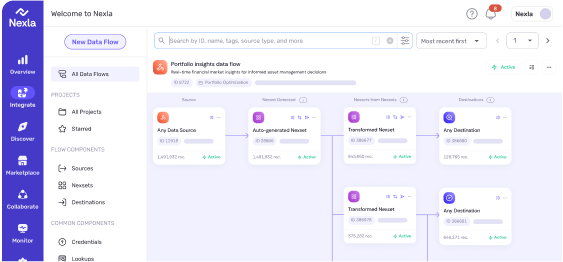
Rather than querying raw data across multiple systems, Nexsets package each dataset with its definitions, validation rules, lineage, and cross-system relationships already resolved. Conflicts are settled at the source before the query runs, not during retrieval.
Agentic chunking handles the document side of the same problem. Standard chunking splits documents into fixed intervals, stripping headings, tables, and relationships out of context. Agentic chunking splits by meaningful unit, so each retrieved chunk still carries the structure that makes it interpretable.
The Common Data Model resolves entity definition conflicts across all connected systems before the agent retrieves anything. When an agent runs a refund eligibility query, “customer” is matched against a single agreed-upon definition before retrieval begins.
The result is a single, validated answer returned in under two seconds with no conflicting definitions to reconcile.
Key Takeaways
- Audit what is feeding the agent’s context window before expanding it. More data from sources with unresolved conflicts lowers accuracy, not raises it.
- Separate reasoning problems from judgment problems before scoping a context graph project. Graphs can automate the first.
- Token limits are not the main constraint. The main constraint is whether retrieved data is consistent, validated, and relevant before it enters the window.
- Resolve entity definitions at the data layer before retrieval. Schema, relationships, temporal validity, and provenance all need to be attached to the data, not inferred by the agent mid-query.
- Start with one high-traffic agent workflow and trace each data source back to its definition. Most teams discover the conflict exists at the source, not in the model, and fixing it there removes an entire category of retrieval errors.
Next Step
Pick one agent workflow where accuracy has dropped as the number of connected data sources grew. Check the inputs for conflicting entity definitions, records without lineage, and data without validation rules.
Want to see how Nexsets deliver?
Schedule a demo to see how Nexsets deliver clean, consistent context to agents in production. Or try Express.dev to go from prompt to pipeline in minutes.
FAQs
Why do context graphs make agents worse?
Because more data sources mean more competing definitions of the same entities. The graph records all of them and the agent has no basis for choosing between them, so it produces a synthesized answer that fits no single source correctly. The problem is in the inputs, not the model.
How do you optimize context graphs for agents?
Treat context graph optimization as a data problem. Identify entities that appear across multiple source systems and establish a single agreed-upon definition for each. Build validation and lineage into every data product the agent queries so failures surface at the data layer.
What role does semantic structure play in AI agent context?
Semantic structure packages each entity, relationship, and validation rule with the data. Agents retrieve accurate, conflict-free information, enabling reliable decisions without guessing.

 Express —