The short answer. You give AI agents access to enterprise data by adding a governed data product layer on top of your existing warehouses, lakes, and operational systems, exposed through MCP or function-calling. The fastest 2026 enterprise pattern is a managed data fabric with MCP output, sitting above the stack you already run. You do not migrate data. You wrap it.
The instinct to rebuild, and why it is wrong
The first reaction most teams have when an agent project lands is to re-platform: new warehouse, new feature store, new vector database, new everything, all chosen specifically for AI workloads. Sometimes that is right. Most of the time it is the slowest possible path to value, and it puts a multi-quarter data migration in front of the actual agent work.
The faster path is layered, not rebuilt. Your warehouse is fine. Your lake is fine. The integration debt across your SaaS sprawl is not fine, but you can address it with a layer rather than a replacement.
Why teams default to rebuild
The pull toward a rebuild is real, and it comes from three places.
The first is the sunk-cost narrative. Most enterprises have spent years standing up a warehouse, building a feature store, hiring data scientists, and writing connectors. When AI agents arrive as a new workload, the instinct is to extend the same project. A new module, a new initiative, a new platform team. That framing makes the new investment feel like the continuation of work already underway, even when the new requirements (discovery, runtime governance, agent write paths) demand a different architecture.
The second is the assumption that “our data is different.” Every enterprise believes the long tail of its SaaS apps, the quirks of its operational stores, and the realities of its data residency rules are unique enough to justify in-house plumbing. Some of that is true. Almost none of it requires writing your own connector library, your own MCP server, or your own RBAC propagation layer.
The third is vendor lock-in fear. Teams reason that buying a managed platform locks them in, while building locks them in only to their own code. In practice the opposite is more common. A managed platform you can swap out is easier to leave than a four-engineer-year homebrew system documented in five Notion pages.
The four-step layered approach
- Pick three agent use cases. Resist the temptation to plan for ten. Pick the three with the clearest business sponsors. Write down the data products each will need, not the tables, the products.
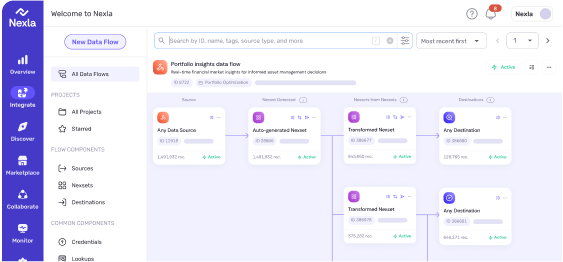
- Stand up a data fabric on top of your existing sources. The fabric pulls from your warehouse, your lake, your SaaS systems, your operational databases, without moving the data of record. It produces governed data products (Nexsets, in Nexla’s terms).
- Expose the data products through an MCP server. Tool-level RBAC, dynamic discovery, per-agent quotas. The MCP server is the agent-facing contract; the fabric underneath does the work.
- Wire eval and observability before you wire the agents. Faithfulness, relevancy, freshness, per-agent telemetry. Without this, the first prompt regression will silently break production.
What makes the layered approach work is that each step is a contract, not a migration. The fabric does not replace the warehouse; it reads from it. The MCP server does not replace your APIs; it discovers and wraps them. Each layer is independently swappable, which is also why the architecture survives the next change in agent runtimes, vector databases, or governance regulations.
What you do not have to migrate
This is the part most teams underestimate. The layered approach intentionally leaves the following in place:
- Your warehouse. Snowflake, BigQuery, Redshift, Databricks, all fine. They become a source to the fabric.
- Your lake. Delta, Iceberg, Hudi, fine. Read in place.
- Your SaaS systems. Salesforce, NetSuite, Workday, connector-based access through the fabric, not migration.
- Your operational databases. Read replicas or CDC, fed into the fabric without affecting the application stack.
- Your existing governance. ACLs and RBAC at the source are preserved and propagated through the fabric.
A reference architecture for 2026
The shape that has emerged across enterprise deployments looks like this. At the bottom: existing systems of record, warehouses, lakes, SaaS, operational stores, file systems. In the middle: a data fabric that integrates them and produces governed data products with consistent governance, lineage, and freshness contracts. Above that: an MCP server that exposes those products as agent-callable tools, with RBAC and observability. At the top: agent runtimes, LangGraph, AutoGen, Bedrock AgentCore, Snowflake Cortex, the Gemini Agent Platform, calling the MCP server.
That architecture is vendor-neutral by design. Swap any agent runtime in or out without touching the data layer. Swap any source system without touching the agents.
The 2026 stack for AI agents
Click any layer to see what lives there, who builds it, and what you buy.
Agent runtimes
LangGraph, AutoGen, Bedrock AgentCore, Gemini Agent Platform
▾
MCP serverNexla layer
Agent-callable tools, per-tool RBAC, discovery, quotas
▾
Data fabric (Nexsets)Nexla layer
Governed data products, lineage, freshness contracts
▾
Sources of record
Warehouses, lakes, SaaS apps, operational databases, files
▾
Click any layer above to see what lives there, who owns it, and the build-versus-buy trade-off.
Walkthrough: how an agent meets a governed data product
The mechanics matter. A typical request flows through the stack like this.
An end user (or an upstream agent) asks a question: which Tier-1 customers have an open P1 incident this quarter? The agent runtime receives the request and queries its MCP server for available tools. The MCP server returns a scoped catalog, only the tools this agent’s service account is allowed to see, with descriptions the agent can reason about.
The agent picks two tools: one that returns Tier-1 customer status from the CRM and one that lists open P1 tickets from the support system. Each tool call hits the data fabric, which translates the agent’s request into source-specific queries, joins the results, applies the caller’s row-level security, and returns a governed result with lineage attached.
The agent synthesizes the answer, the MCP server logs every tool call, and your audit log has a complete record (user, prompt, tools, sources, timestamps) for the compliance team to read later. Nothing in this flow required re-platforming. The warehouse stayed where it was. The CRM stayed where it was. The agent never touched either of them directly.
Common mistakes
- Letting agents call the warehouse directly. Looks fast in a demo, falls apart at production governance and observability.
- Treating the vector database as the data layer. It is one retriever among several. The data products feed it.
- Skipping the eval layer. Without it, the first quiet regression destroys trust and the project.
- Building the MCP server by hand. Possible, but expensive to maintain. The connector library and governance are where vendors earn their fee.
- Underestimating the SaaS long tail. The data your agents need most is often in systems that never made it into the warehouse.
A 90-day plan
How long does this take, really?
Same scope, two approaches. Drag the sliders to see how the gap widens.
90-day mark
NexlaWith a managed platform
1w
DIY build from scratch
10w
An order of magnitude faster. A managed data platform absorbs the connector library, governance plumbing, and MCP server you would otherwise build by hand.
Weeks 1–2: select three use cases and the data products they need. Weeks 3–6: stand up the fabric, connect the top sources, define the products. Weeks 7–9: expose products via MCP, wire RBAC and quotas. Weeks 10–12: stand up evals, telemetry, and the first agent pointing at the new layer. By the end of the quarter, you have a production-shaped path that scales to the next ten agents without re-architecting.
FAQ
Do we have to use MCP?
Strongly recommended in 2026, but function-calling endpoints work too. The principle, a governed, discoverable agent-facing contract, is what matters.
Can we do this with open source only?
You can. Plan for the engineering and security cost of running the connector library, the governance layer, and the MCP server yourself. Many teams start there and migrate to a managed platform when the cost catches up.
How does this interact with our warehouse vendor?
It complements it. The warehouse stays as a source of record; the fabric and MCP server sit above it. No re-platform required.
What if our data is not AI-ready yet?
Start with the data products the first agents need. That scopes the AI-readiness problem to a manageable surface rather than a multi-year program.
What if we already started rebuilding?
Stop adding scope. Most rebuilds that hit production were repurposed mid-flight from rebuild-the-whole-stack to layer-on-top-of-it. The work you have already done on schemas, governance policies, and team ownership transfers to the layered approach. The connector glue and MCP plumbing you have not yet written is the part you let a platform absorb.
How does this work in regulated industries?
In regulated industries the layered approach helps, not hurts. Lineage and audit live in the fabric and the MCP server, not scattered across application code. Data residency stays at the source, where it was always meant to be. The trade-off is operational: a regulated environment may need to host the data platform inside its own VPC rather than in a vendor cloud.
Can we adopt this incrementally?
Yes, and you should. The fastest path is one agent at a time. Expose two or three data products through MCP, point a single agent at them, run for a quarter, then expand. The platform absorbs new sources and products as you add them. There is no big-bang migration.
What about the team running our current data platform?
Their work changes shape. Instead of writing and maintaining connector code, they become product owners of data products: defining the contract, governing access, monitoring freshness. It is closer to data product management than to data engineering, and most of the team prefers it.
Next step
With the access layer in place, the next decision is how agents reason over what they retrieve, the case for or against agentic RAG. The companion pillar walks through when to use it and when classic RAG is still the right answer.