Data Platform for AI Agents: 7 Capabilities to Demand
A data platform for AI agents must do 7 things: connect, abstract, govern, deliver, act, observe, secure. Use this checklist to evaluate any vendor or stack.
Introducing  Express — Go from prompt to pipeline in minutes.

The short answer. The Model Context Protocol (MCP) is an open standard, introduced by Anthropic in November 2024 and donated to the Linux Foundation’s Agentic AI Foundation in 2025, that lets AI agents discover and call tools and data sources at runtime. For enterprise data teams, MCP servers are the new contract layer between agents and governed data, a discovery-first alternative to writing one-off API integrations per agent.
MCP began as Anthropic’s open spec for connecting AI assistants to tools without bespoke glue. It now has co-stewardship from OpenAI, Block, Google, Microsoft, AWS, and Cloudflare. Anthropic reports more than 10,000 public MCP servers and 97 million monthly SDK downloads.
By Q1 2026, 78% of enterprise AI teams with fifty or more practitioners had at least one MCP-backed agent in production, up from 31% a year earlier. Enterprise adoption among organizations of 250+ employees sits near 89%.
For data teams, the protocol matters because it inverts who knows the schema. APIs assume the client knows what to call. MCP assumes the agent will ask, at runtime, what tools exist, and the server will tell it.
| Dimension | API | MCP server |
|---|---|---|
| Designed for | Code written by humans | Agents choosing tools at runtime |
| Discovery | Static docs (Swagger) | tools/list returned dynamically |
| State | Stateless requests | Session-based, capability-scoped |
| Failure mode | 4xx / 5xx | Tool refusal with structured context |
| Scaling pattern | Decades of HTTP at scale | Tool overload, prompt budget pressure |
| Best for | Programmatic integrations | Agentic, multi-tool workflows |
Drag the sliders to see how much of the agent’s context window is burned on tool descriptions before reasoning starts.
The compact rule of thumb: APIs are the right answer when you write the program. MCP is the right answer when the AI is the program.
Four patterns dominate.
Adjust your situation. The match score updates per pattern, top score is recommended.
Most MCP servers in the wild are toy projects. Enterprise teams should expect, at minimum:
Most MCP servers expose pre-built APIs as tools. Few let agents compose new data flows.
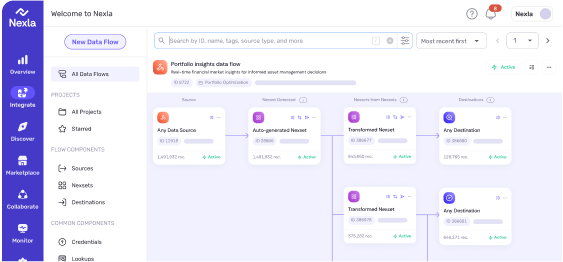
Nexla creates dynamic MCP access across 550+ enterprise sources, including systems that lack native MCP support such as SAP, Coupa, Workday, and IBM DB2. The same server presents governed Nexsets (Nexla’s data products with semantic abstraction), applies built-in access controls and audit logging, and unifies disparate systems behind a single MCP endpoint. Built-in governance, zero-trust security, and identity travel with every call, so agents get a single tool surface without compromising on enterprise controls.
A reasonable starting point in 2026: buy your enterprise data MCP layer, build the agent-side orchestration. The MCP server is plumbing, it needs governance, uptime, audit, and a connector library that’s expensive to rebuild. Your agent reasoning is your differentiation.
An open protocol that lets AI agents discover and call tools and data sources at runtime, without hand-coded API clients.
No. MCP usually wraps APIs. The protocol gives agents a discovery and call interface; the API underneath still does the work.
The Linux Foundation’s Agentic AI Foundation, co-founded by Anthropic, Block, and OpenAI in late 2025.
Yes. The data fabric organizes data; the MCP server makes it agent-callable. They compose; they do not substitute.
Pick one agent use case that today depends on hand-coded API glue. Re-implement that integration behind an MCP server. The exercise will surface every gap in your current data governance, cheaper now than at scale.
A data platform for AI agents must do 7 things: connect, abstract, govern, deliver, act, observe, secure. Use this checklist to evaluate any vendor or stack.
Give AI agents secure access to enterprise data without rebuilding your stack. Compare DIY vs. managed paths, see a 1-week vs. 12-week timeline, pick what fits.
Agentic RAG replaces static retrieval with planning, tool use, and reflection. See the architecture, when to choose it over RAG, and metrics that actually matter.