The Context Graph Paradox: When More Data Makes AI Agents Worse
Discover why context graphs fail at scale and how semantic structure delivers reliable runtime context for enterprise AI agents.
By Nexla Team
Introducing  Express — Go from prompt to pipeline in minutes.

As businesses grow increasingly data-driven, robust ETL (Extract, Transform, Load) solutions become critical to efficiently manage vast datasets. At Nexla, we’ve integrated Spark ETL with Databricks to deliver a flexible, scalable, and high-performance data processing solution. This blog dives deep into how Nexla’s Spark ETL works, its benefits, and the technical details behind its integration with Databricks.
Nexla’s Spark ETL on Databricks is a powerful solution for handling complex data workflows. Leveraging the computational might of Spark distributed clusters and Databricks, this integration empowers data teams to streamline their data processing at scale. Here’s a breakdown of its core capabilities:
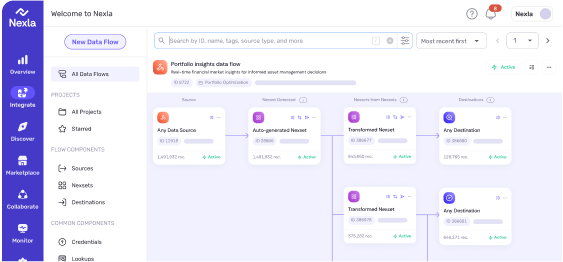
When setting up the ETL flow, Nexla offers a user-friendly interface for selecting data sources.You can seamlessly connect to your Databricks cluster for compute without any performance impact.
Nexla allows users to define transformations similar to its standard flows. Basic operations like creating new columns or modifying existing ones can be done no-code or with Spark SQL supporting ANSI-standard SQL for transformations. What’s more, Nexla ensures smooth previews using SQL during pipeline design using the data samples, allowing users to verify the SQL they’ve written before it will be executed on the cluster.
Like the source setup, the destination configuration can either point to a cloud storage location or a delta table. Once the destination is defined, the flow is ready for execution.
Pic.1 – Nexla Flow definition example
Pic. 2 – Medallion Architecture example
Once the flow is set, here’s how Nexla’s Spark ETL executes on Databricks:
Pic. 3 – Nexla and Databricks integration
Nexla’s integration with Databricks represents a huge step forward in scaling ETL processes. The out of box integration with Unity Catalog enables all the new features of Databricks like Data Intelligence Platform, GenAI etc. By leveraging Databricks’ powerful compute environment and Spark’s distributed processing capabilities, Nexla provides a flexible, cloud-native solution for transforming and managing data pipelines. Stay tuned for further updates as Nexla continues to enhance its Spark ETL integration with Databricks!
Discover why context graphs fail at scale and how semantic structure delivers reliable runtime context for enterprise AI agents.
Enterprise AI agents fail when the context behind their decisions is incomplete, stale, or conflicting. Context engineering ensures agents receive accurate, permission-aware runtime context for reliable decisions.
Explore how a multimodal AI pipeline built with NVIDIA models, Nebius infrastructure, and Nexla orchestration converts social media travel videos into structured itineraries.