ETL, ELT, and Reverse ETL Built for the Agent Era
Move, transform, and stage enterprise data from any source – structured or unstructured, into governed data products that agents, analytics, and operations can use. No coding required.
Most enterprises run separate tools for ETL, ELT, and reverse ETL and end up with brittle pipelines, inconsistent data, and an engineering backlog that never shrinks. Nexla consolidates ETL, ELT, and R-ETL on one platform, turns every source into a governed data product (Nexset), and delivers it to the warehouses, applications, and AI agents that need it. No custom code. No pipeline fragmentation. No agents to monitor custom coded pipelines.
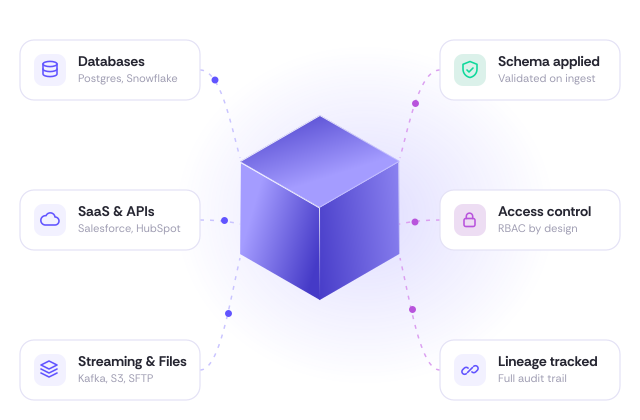
600+ bidirectional connectors for databases, SaaS apps, files, and APIs. Nexla automatically detects schema, extracts metadata, and turns every source into a Nexset – a governed, reusable data product. Without writing custom connector code.
Pick the integration pattern the project needs: ETL to load and transform for the warehouse, ELT to push raw data and transform at destination, or R-ETL to sync data back from the warehouse into operational systems. Build each as a graphical flow without writing code. Combine patterns in a single pipeline when needed.
Nexsets are reusable across every consumer. The same data product that feeds your Snowflake warehouse can serve an AI agent via MCP or power an operational dashboard – with consistent schema, quality rules, and governance built in.
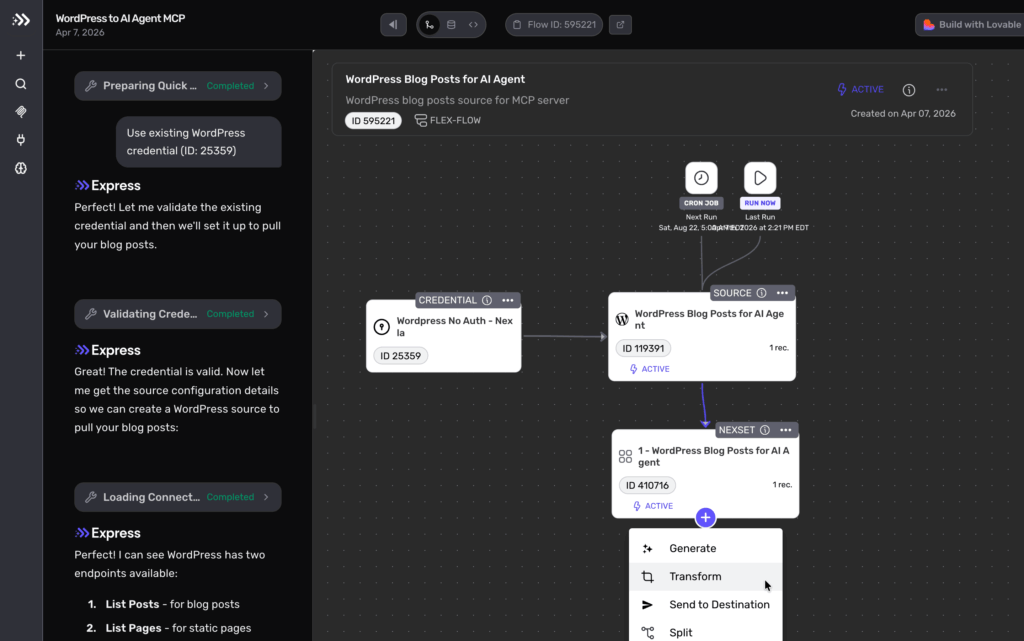
Nexla uses AI to do the integration work. Describe the pipeline you need in plain English. Nexla maps the source, generates the schema, recommends transforms, and builds the flow. Or use the no-code visual designer to point and click. Either way, you go from source to governed data product without writing pipeline code. Use Express.dev for a free, conversational starting point.

600+ bidirectional connectors for SaaS apps, databases, data warehouses, files, APIs, email systems, and on-premises sources. Deep object coverage including custom objects – not surface-level connections. Connect to any REST or SOAP API. The AI connector builder reads an API spec and ships a new typed connector in under a week.

Once connected, Nexla automatically generates a Nexset – a governed virtual data product with schema, metadata, semantic types, lineage, and access controls. Nexsets work with structured data (databases, CSVs, APIs), semi-structured data (JSON, XML), and unstructured data (PDFs, documents, emails). The same Nexset feeds your data warehouse, your analytics stack, and your AI agents via MCP. All without rebuilding the pipeline for each consumer.

Build ETL pipelines to extract, transform, and load data from any source to your warehouse or data lake. Use ELT to push raw data to the destination and apply transforms there. Use Reverse ETL to sync enriched warehouse data back into operational systems like Salesforce, HubSpot, or SAP. Each pattern is built on Nexsets, so the data product is governed and reusable regardless of which pattern created it.

Apply transforms at any stage of the pipeline using a library of pre-built rules: filter, enrich, combine, map, and reshape data without writing code. Use AI prompts to generate transform logic in plain English, build reusable rules in the Nexla Designer, or add SQL, Python, or JavaScript when needed. Preview results and flagged errors at each step so issues surface before data reaches the destination.

As you connect each source, Nexla generates schema validation rules and data quality checks automatically. Add your own rules on top. When schemas change at the source, Nexla detects the drift and handles evolution without breaking the pipeline. Agents and analytics tools that consume a Nexset get data that has passed quality checks at the point of ingestion, not after the fact.

Publish Nexsets to Nexla’s private Data Product Marketplace to share governed data across teams, applications, and AI agents. Access requests go through an approval workflow. Policies set at the Nexset level carry through to every consumer, whether that is a Snowflake pipeline, a business intelligence dashboard, or an AI agent calling via MCP. Manage domains, lineage, and usage across the organization from one place.