The short answer. A data platform for AI agents is the runtime layer that gives autonomous agents discoverable, governed access to enterprise data. In 2026, buyers should demand seven capabilities: source-agnostic connectivity, data product abstraction, real-time and batch in one platform, embedded RBAC and lineage, MCP and function-calling exposure, evaluation and observability, and write paths that let agents build new pipelines.
What this category actually is
“Data platform for AI agents” is a 2026 category, not a rename of data integration. The unit of value is the agent-callable data product, not the pipeline. The buyer is increasingly the CDO or Head of AI Platform, not the analytics team, and the success metric is how many agents the platform can serve without bespoke engineering per agent.
Most vendors in this space evolved from one of three starting points: data integration (Nexla, Fivetran, Informatica), MCP/agent infrastructure (Composio, internal MCP servers), or warehouse-native AI (Snowflake Cortex, Databricks Mosaic). Each path leads to a different set of trade-offs, which is why the capability checklist below matters more than the category label.
1. Source-agnostic connectivity
Agents do not care where data lives. The platform should integrate with warehouses, lakes, SaaS systems, operational databases, streaming sources, file shares, and APIs, with managed connectors, not a brittle long tail of hand-rolled scripts.
What bad looks like: connectors exist for the three sources you have today and a roadmap for the rest. What good looks like: a connector library in the hundreds, plus first-class support for whatever ad-hoc sources matter to your business.
2. Data product abstraction
The platform should let you define a data product once and serve it to every consumer, humans, dashboards, models, agents, without recreating the logic in each.
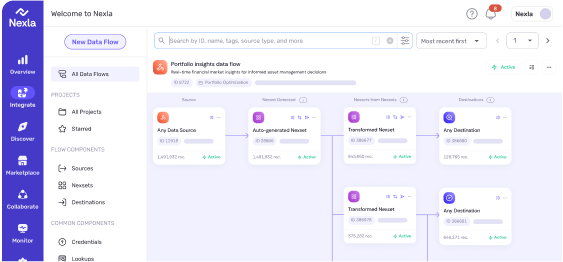
Nexla calls these Nexsets; the generic name is data product. The test: when a new agent is added, does it consume the existing product, or does someone have to build a new pipeline?
3. Real-time and batch in one platform
Agents do not get to wait for nightly ETL. They also do not always need sub-second freshness. The platform should support both, and the same data product should be servable at multiple refresh rates without forking the pipeline.
4. Embedded RBAC and lineage
Every column an agent reads should be traceable to a user, a prompt run, and a data product. Access controls should survive transformations and embeddings, if a user cannot see the row, they should not retrieve its vector.
This is the capability buyers most often discover too late. Retrofitting governance through embeddings is harder than building it in from the start.
5. MCP and function-calling exposure
Data products are useless if agents cannot call them. The platform should expose every product through MCP, the 2026 standard, and through function-calling endpoints for agent runtimes that prefer them.
Demand tool-level RBAC, dynamic discovery, and quotas. Without those, the MCP layer becomes the new attack surface.
6. Evaluation and observability
Pipelines for agents are not pipelines for humans. They need eval datasets, faithfulness and relevancy scoring on every change, freshness monitoring, and per-agent telemetry.
Without this, regressions are silent. You ship a prompt change or a re-embed and quality quietly drops with no alarm.
7. Write paths for agentic pipeline construction
The most differentiating capability in 2026: can the platform let agents not just read existing data products, but compose new ones? An agent that hits a missing data product should be able to propose one, get it through approvals, and ship it without leaving the loop.
This is where Nexla’s MCP positioning is sharpest, its server is built to let agents build pipelines, not just call them. Whether you buy that specific platform or not, this is the capability that separates a 2024 integration vendor wearing new branding from a real 2026 data platform for agents.
Buyer’s checklist
Capability
Minimum bar
Source-agnostic connectivity
Hundreds of managed connectors, plus custom
Data product abstraction
Define once, serve many consumers
Real-time + batch
Same product, multiple refresh rates
Embedded RBAC and lineage
Enforced through embeddings, end-to-end
MCP / function-calling
Tool-level RBAC, dynamic discovery, quotas
Eval and observability
Per-agent metrics, regression alerts
Write paths for agents
Agents can build, not just call
How do data platform archetypes cover the 7 capabilities?
Click an archetype column to see why it scores that way. Adjust your priorities below to see which archetype fits.
Capability
Warehouse-native
Connector vendor
MCP gateway
Data platform for agents
Tap a column header to see detail
Or read all four below
Each archetype trades coverage for depth. Strong (3 dots) means designed for it; partial (1 dot) means it works with caveats; gap means rebuild it yourself.
Weight your priorities
Top match for your priorities:Data platform for agents
Coverage assessment is illustrative. Real vendors blur category lines; treat as a heuristic, not a procurement spec.
FAQ
Is this the same as a data integration platform?
It is the agent-era evolution of one. The base capability, moving and shaping data, is the same. The added capabilities (data products, MCP, agent governance, eval) are what define the new category.
Can my warehouse vendor cover all seven?
Often partially. Warehouse-native options are strongest on storage and analytics; weakest on cross-source coverage and vendor neutrality.
How important is vendor neutrality?
Very. Locking the data layer to one model provider or one warehouse undermines every agent strategy that assumes a multi-model, multi-cloud future.
Where does Nexla fit?
Nexla positions itself as the data platform for agents specifically, Nexsets as the product abstraction, an MCP server that supports building pipelines, and governance layered through both.
Next step
The companion how-to post walks through giving agents access to enterprise data without rebuilding the stack underneath, a practical follow-on to this checklist.
MCP Security That Uses Your Identity, Your Credentials, and Your Policies
As AI agents reach into enterprise systems, the question is not whether they can connect, but whether they do it without bypassing your security controls. Here is how Nexla keeps MCP access tied to each user’s identity and credentials, and lets your systems keep enforcing their own policies.
MCP Tool Bench is a controlled way to benchmark MCP server design. We put Nexla’s task-specific MCP servers against off-the-shelf ones on real BigQuery tasks, in two harnesses, and measured the agent effort each demanded.