Meet Nexie: AI Agent for Anyone Evaluating Nexla
Meet Nexie, the AI knowledge agent on nexla.com that answers your hardest questions about agentic data integration, without the sales pitch.
Jun 15, 2026

Most startup companies aim to be data-driven, but they rarely fail from a lack of data. Their real challenge is using data quickly and effectively. Customer records, product logs, and SaaS platforms all generate streams of information. However, limited engineering capacity makes it challenging to connect them all.
Many companies end up relying on a patchwork of scripts, manual exports, or unreliable connectors that break down the moment the businesses start to grow. Choosing the wrong ETL (Extract, Transform, Load) tool only makes these problems worse. The consequence is rising hidden costs, fragile pipelines, and growing technical debt that slow progress after just a few months of growth.
Automated ETL tools are designed to solve these challenges. The right tool ensures data flows smoothly, grows alongside the business, and frees your technical teams from constant troubleshooting. This article explains how startups should select the right ETL tools, avoid common mistakes, and choose frameworks that enable the startup businesses to scale confidently.
Figure 1: Overview of ETL Process Steps: Extract – Transform – Load
Automated ETL is the process of automatically moving data from multiple sources, transforming it through cleaning and reformatting, and then loading it into an analytics warehouse, database, or data lake.
These ETL tools minimize coding and manual effort while offering features such as error detection, retry logic, and failure recovery without human intervention. They help startups integrate with common data sources from SaaS platforms like Salesforce and HubSpot, as well as various databases, APIs, and cloud storage systems.
Where traditional ETL solutions can take weeks or months to develop, today’s automated tools enable the deployment of new pipelines and integrations in just hours or days. This speed advantage lets startups focus on product development rather than troubleshooting.
Automated ETL offers several clear advantages to startups, such as:
While automated ETL solutions offer benefits, startups face many difficulties when building the required data infrastructure from scratch. Some of these challenges include:
Due to these reasons, there is a clear need for previously developed automated ETL tools that can simplify and accelerate the process of pipeline creation, especially for startups. However, with so many options of ETL tools available in the market, selecting the right platform can be overwhelming for startups. This makes it essential to understand the key evaluation factors, which we will discuss below.
Picking an ETL tool for a startup requires balancing several technical and financial limits. Therefore, when evaluating, consider these essential factors:
Below is an overview of the most startup-friendly automated ETL tools, grouped into categories to make selection easier:
Cloud-native tools are fully managed SaaS and cloud-hosted ETL solutions that are easy to set up and offer automatic scaling. They are typically hosted on public or private cloud platforms. These tools are good for startups that prioritize speed and reliability over heavy customization. Some popular cloud-native tools include:
Open-source ETL options are flexible and have features for high customization, with no separate licensing costs. However, they often require more technical resources and ongoing maintenance. These tools are best for technical teams such as DevOps engineers who are comfortable with the command-line interfaces and want maximum control. Some examples include:
No-code or low-code ETL tools are the simplest and are generally built for non-technical business users. They provide drag-and-drop user interfaces (UIs) and require minimal technical knowledge. However, they are less flexible for custom transformations or scaling for complex edge cases. They work best for teams with limited engineering resources, handling lightweight to moderate ETL tasks.
Some popular options for no-code and low-code automated ETL tools include:
Enterprise-ready tools are mostly targeted for mature startups as they provide some advanced automation features with enterprise-standard support and several other functionalities. Although these tools have slightly higher costs than the other tools, they are more suitable for well-funded startups with complex data needs and guaranteed uptime requirements. These include options like:
Hybrid automation ETL platforms offer a balance of automation and customization for complex transformations and scalable workflows. They address advanced needs such as real-time data processing, AI-powered schema detection, and custom transformation logic without the overhead of full enterprise solutions.
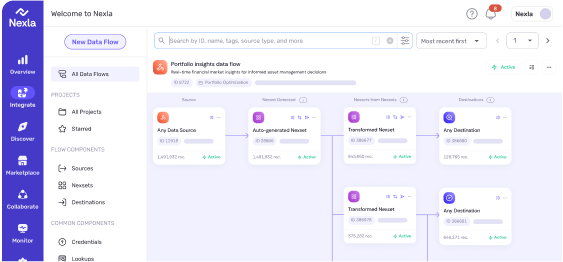
Nexla combines a low-code interface with AI-assisted capabilities. Its core innovation, Nexsets, provides virtual data products that abstract complex data sources, enabling seamless integration regardless of format or structure.
Figure 2: Nexla as an All in One Automated ETL Platform
Nexla supports both batch and streaming data, includes automated schema recognition, and simplifies pipeline creation with AI. Its usage-based pricing model makes it a practical choice for startups seeking advanced features with manageable complexity.
Here is a quick table summarizing the common features of automated ETL tools:
| ETL Category | Best For | Pros | Cons | Examples |
| Cloud Native | Startups that need speed and reliability | Easy setup, automatic scaling, managed service | Limited deep customization features | AWS Glue, Google Cloud Dataflow |
| Open Source | Technical teams (DevOps, engineers) | Free licensing, high flexibility, customizable | Requires more resources and ongoing maintenance | Airbyte, Apache Airflow |
| No-Code or Low-Code | Non-technical or lean engineering teams | Drag-and-drop UI, fast onboarding | Less flexible for complex scaling | Integrate.io, Skyvia |
| Enterprise Ready | Well-funded startups with complex needs | Enterprise support, high uptime, advanced automation | Higher cost | IBM DataStage, Azure Data Factory |
| Hybrid Automation | Scaling startups that need a balance and AI features | Mix of automation and customization, AI-driven tools | More complex than no-code options | Nexla |
Following best practices ensures your ETL setup grows with the business, avoids costly rework, and delivers reliable data for decision-making. Consider the following guidelines:
Nexla helps implement the above best practices through its comprehensive features to support startups. The platform’s Nexsets feature and the AI-powered metadata intelligence automatically discover and map complex data relationships across different systems from SaaS to cloud storage, and update frequencies.
This allows teams to work with data from various sources without needing to understand the technical details of each system. It also eliminates much of the manual configuration work that typically slows down the data integration projects. Users can handle both structured and unstructured data through automated parsing and intelligent transformation suggestions.
Figure 3: Nexsets Turn Raw Data into Reusable, AI-Ready Data Products For Faster Integration
Nexla’s visual pipeline builder features the NOVA natural language AI assistant, which helps create complex data workflows using natural language instructions. This approach makes advanced data integration accessible to business users, analysts, and technical specialists. Moreover, the platform includes built-in compliance features like automatic data lineage tracking, access and usage controls, and audit trails to ensure secure data governance.
The system offers production-grade reliability, featuring real-time monitoring and intelligent error recovery. Its auto-scaling infrastructure handles growth from startup volumes to enterprise scale automatically. This combination of usage-based pricing, ease of use, automation, and reliability helps startups build data capabilities that grow with their business needs.
Choosing the right automated ETL tool sets the foundation for your startup’s data operations and future analytics capabilities. Start by defining clear business needs, budget constraints, and future growth plans. Focus on the tools that offer ease of use, automated reliability, and a pricing model rather than new advanced features you may not need initially. Run and test a few top ETL options on some live, real-world data scenarios before making a final choice.
The right choice prevents technical debt, accelerates insights, and gives your team the bandwidth to focus on the latest innovation rather than constant fixes.
See how Nexla delivers on these priorities. Schedule a demo today to experience its automation, scalability, and intelligent data management in action.
Meet Nexie, the AI knowledge agent on nexla.com that answers your hardest questions about agentic data integration, without the sales pitch.
A separate MCP server per app doesn’t scale. See why task-specific, governed MCP servers across your systems are the future, with Nexla MCP Studio.
Raw RAG systems still hallucinate because they lack business context. Learn how semantic abstraction and Nexsets improve AI agent reliability.